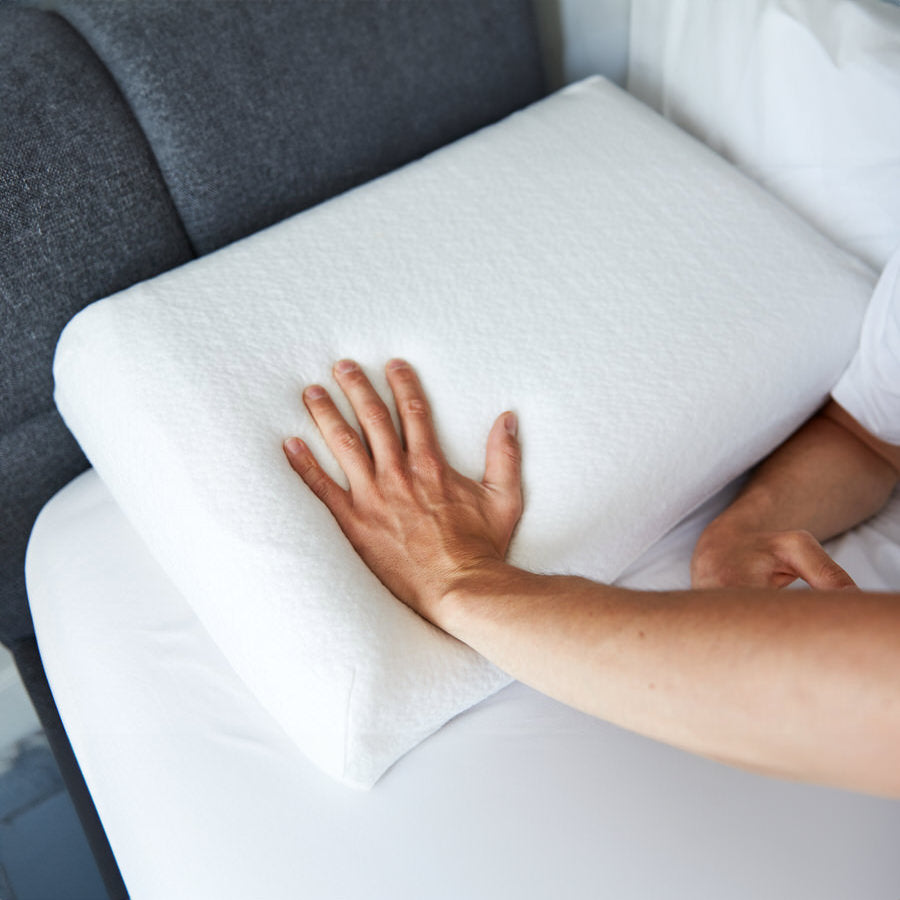
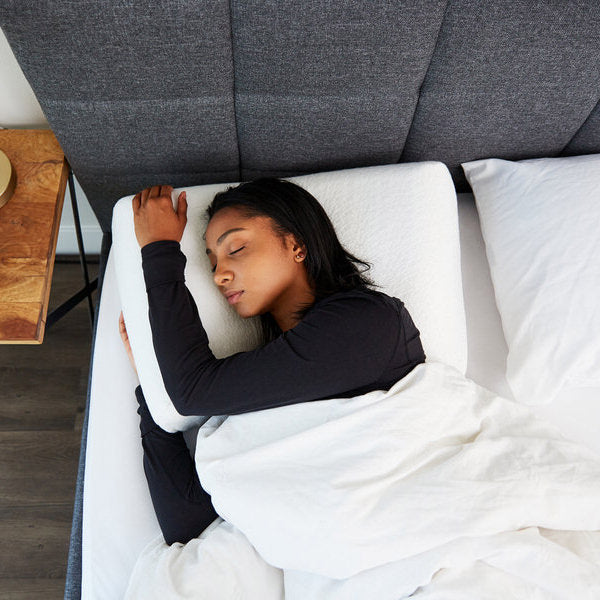
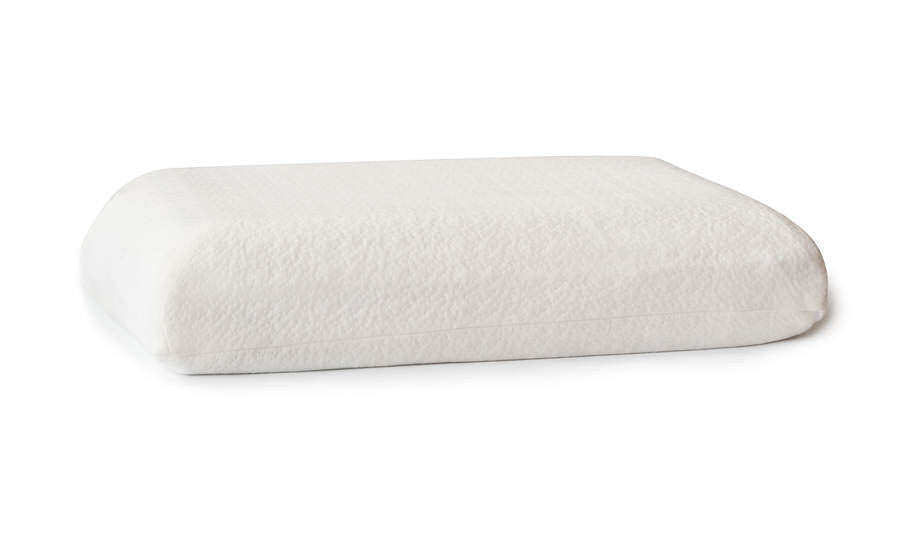
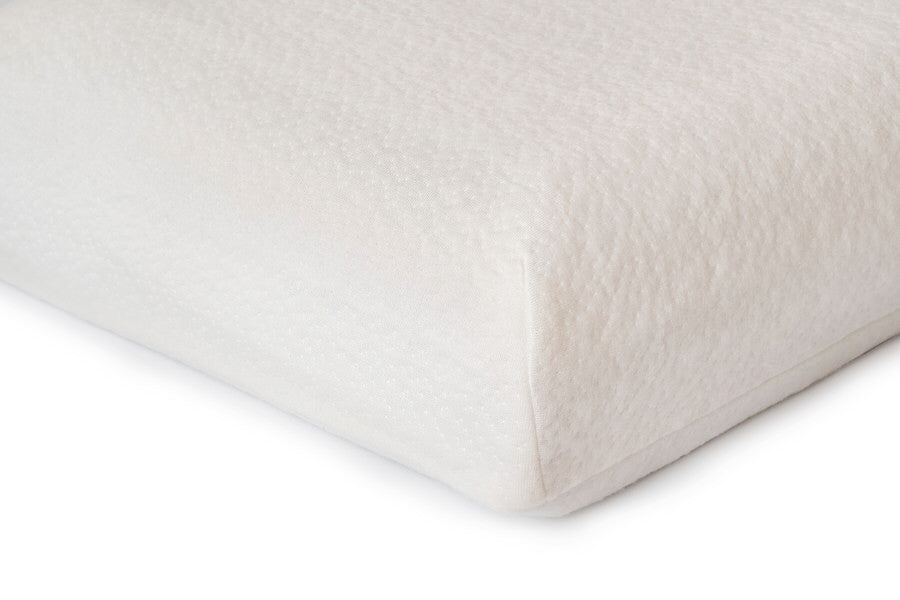
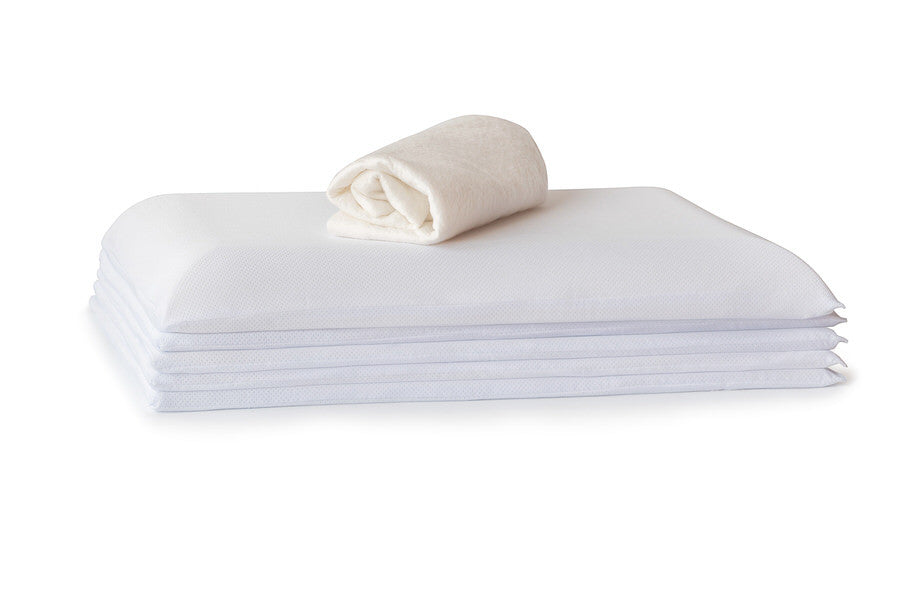
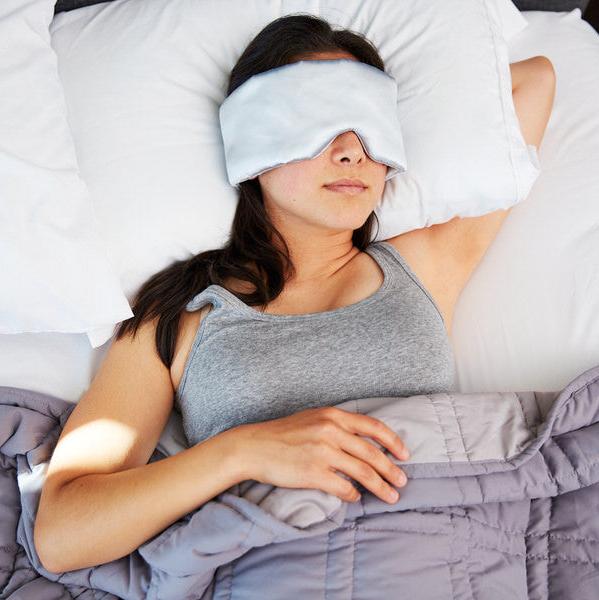
The best pillow for a stomach sleeper is thin, soft, and breathable. It’s a simple combination, but it's the key to preventing neck strain by keeping your head level with the mattress. The goal? Making sure your spine stays in a comfortable, neutral alignment all night long.
The Stomach Sleeper's Dilemma: Why Your Pillow Matters
If you're a stomach sleeper who regularly wakes up with a stiff neck or a dull ache in your lower back, you're not alone. It's an incredibly common problem. The issue isn't always the position itself but the gear you're using—especially your pillow.
The truth is, most pillows just aren't designed for people who sleep face-down. They're built for back or side sleepers, which creates a huge problem.
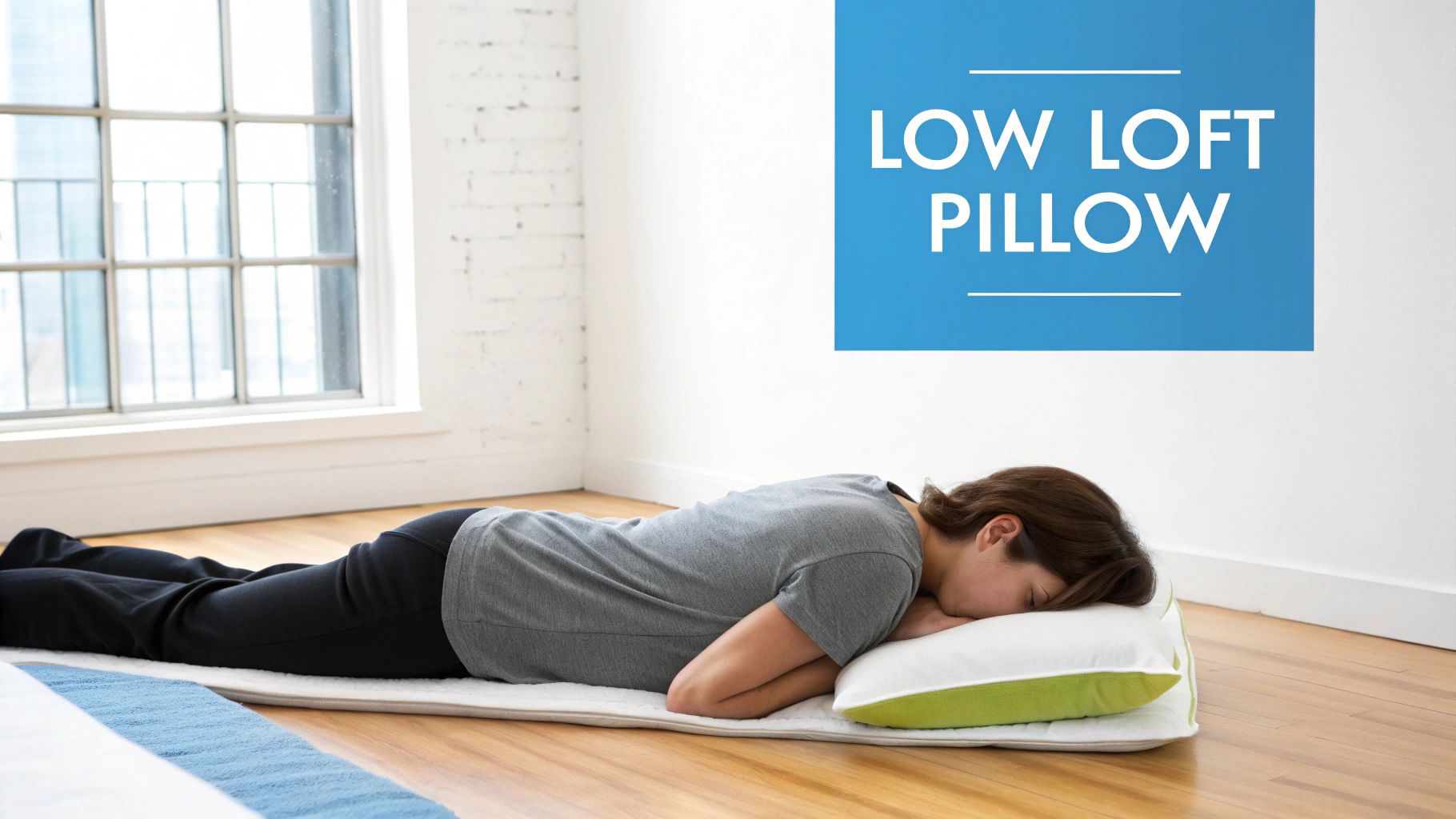
Think of your spine as a straight line from your head to your hips. When you lie on your stomach with a thick, fluffy pillow, you're cranking your head and neck upward at a seriously unnatural angle. It’s like staring up at the ceiling for hours on end, and it puts a massive strain on the muscles in your neck and upper back.
The Chain Reaction of Bad Support
That awkward angle doesn’t just stop at your neck. It triggers a chain reaction that travels down your entire spine. As your neck bends up, your lower back often arches too far to compensate. This is what leads to that all-too-familiar morning soreness and can cause long-term discomfort if you don't fix it.
No matter how you sleep, the main goal is to achieve neutral spinal alignment, where your head, neck, and spine form a relatively straight line. For stomach sleepers, this means a pillow that's barely there—just enough cushion for comfort without propping your head up. This is exactly why finding the right pillow is so important for waking up pain-free.
A pillow that’s too high is the number one cause of morning neck pain for stomach sleepers. The ideal pillow should allow your head to rest nearly flat against the mattress, preserving the natural curve of your spine without creating any upward tension.
Why You Can’t Just Ignore Your Pillow
More and more people are realizing how much proper sleep support impacts their overall health, and the demand for specialized solutions is growing. The global pillow market was valued at USD 9.04 billion in 2025 and is projected to hit USD 11.89 billion by 2029.
This growth is being driven by a new focus on ergonomics and products designed for specific sleep positions. It just goes to show you're not the only one looking for a better way to sleep.
Making an informed choice is the first step toward better rest. For a deeper dive into selecting the right support, check out a comprehensive guide to choosing the right pillow. It'll walk you through the core principles and set you up for a much happier, pain-free morning.
How Pillow Loft and Firmness Impact Spinal Alignment
Picture your spine as a straight, level road. When you're sleeping on your stomach, the entire game is about keeping that road perfectly flat from your head down to your hips. The two make-or-break factors here are pillow loft and pillow firmness. Getting these wrong is a surefire ticket to waking up with a sore neck.
Loft is just a fancy word for your pillow's height or thickness. For a stomach sleeper, a high-loft pillow is like sticking a massive speed bump in that road, cranking your neck up at a painful angle. That upward tilt puts immediate strain on the muscles and vertebrae, and it doesn't take long for stiffness and pain to set in.
Firmness, on the other hand, is all about how much your head sinks into the pillow. If it's too firm, it's like resting your head on a concrete block—it just won't give. But if it's way too soft, your head might sink right through to the mattress, offering zero support. The sweet spot is a delicate balance between the two.
Finding the Right Loft for Stomach Sleepers
When it comes to loft, the rule for stomach sleepers is simple: lower is always better. You're looking for a pillow with a very low profile, typically somewhere between 2 to 3 inches thick. This minimal height keeps your head almost perfectly level with the mattress, which is exactly what you need to maintain that neutral spinal alignment.
Anything thicker than about 3 inches is almost guaranteed to force your neck into an unnatural upward curve. This doesn't just trigger neck pain; it can create a ripple effect of misalignment down your entire back. In fact, many stomach sleepers find that no pillow at all feels best, but a super-thin one can provide just the right amount of soft cushioning without wrecking your posture.
A low-loft pillow is the absolute foundation of comfort for anyone who prefers sleeping face-down.
The Perfect Firmness Level
While loft deals with height, firmness is all about the feel and support. For stomach sleepers, the ideal pillow is soft to medium-firm. It needs to be soft enough to comfortably cushion your face and let your head sink down, but it also has to have just enough substance to keep you from bottoming out on the mattress.
Here’s a quick rundown of why that balance is so critical:
- Too Firm: A rock-solid pillow will fight against the weight of your head, creating that significant upward angle that strains your neck.
- Too Soft: A pillow with no real structure (think of an old, flat-as-a-pancake feather pillow) can let your head sink too far, which might even make it harder to breathe.
- Just Right: A soft-to-medium pillow cradles your head, taking the pressure off while still maintaining that all-important low profile.
The perfect pillow for a stomach sleeper should feel almost invisible. It provides just enough cushioning for comfort without actively propping your head up, allowing your spine to rest in its natural, straight alignment.
Nailing this balance is the secret to avoiding those morning aches and pains that plague so many stomach sleepers. Learning how to dial in these factors is a huge step toward better rest, and an adjustable pillow for neck pain can be a game-changer, giving you the power to find your personal perfect loft and firmness.
If you're exploring other ergonomic designs, you might also look at specialized options like the Neptune Contour Pillow, which is engineered specifically to support the neck's natural curve. Ultimately, the goal is to find the pillow that helps you keep that "road" for your spine as straight and smooth as possible, so you can wake up feeling refreshed and pain-free.
Choosing The Right Pillow Materials For Comfort And Support
Okay, so we've established that a thin, soft pillow is your best friend. But what's inside that pillow is just as critical as its height. The fill material directly dictates how the pillow feels, how well it breathes, and whether it can give you that barely-there support stomach sleepers need.
Choosing the right material is a bit of a balancing act. You're looking for something that can squish down to a low profile but still offer a gentle cushion for your head. Let's break down the most common options and see how they stack up in the real world.
This simple guide nails the two most important factors for any stomach sleeper: aim for a low loft and a soft firmness to keep your spine happy and aligned.
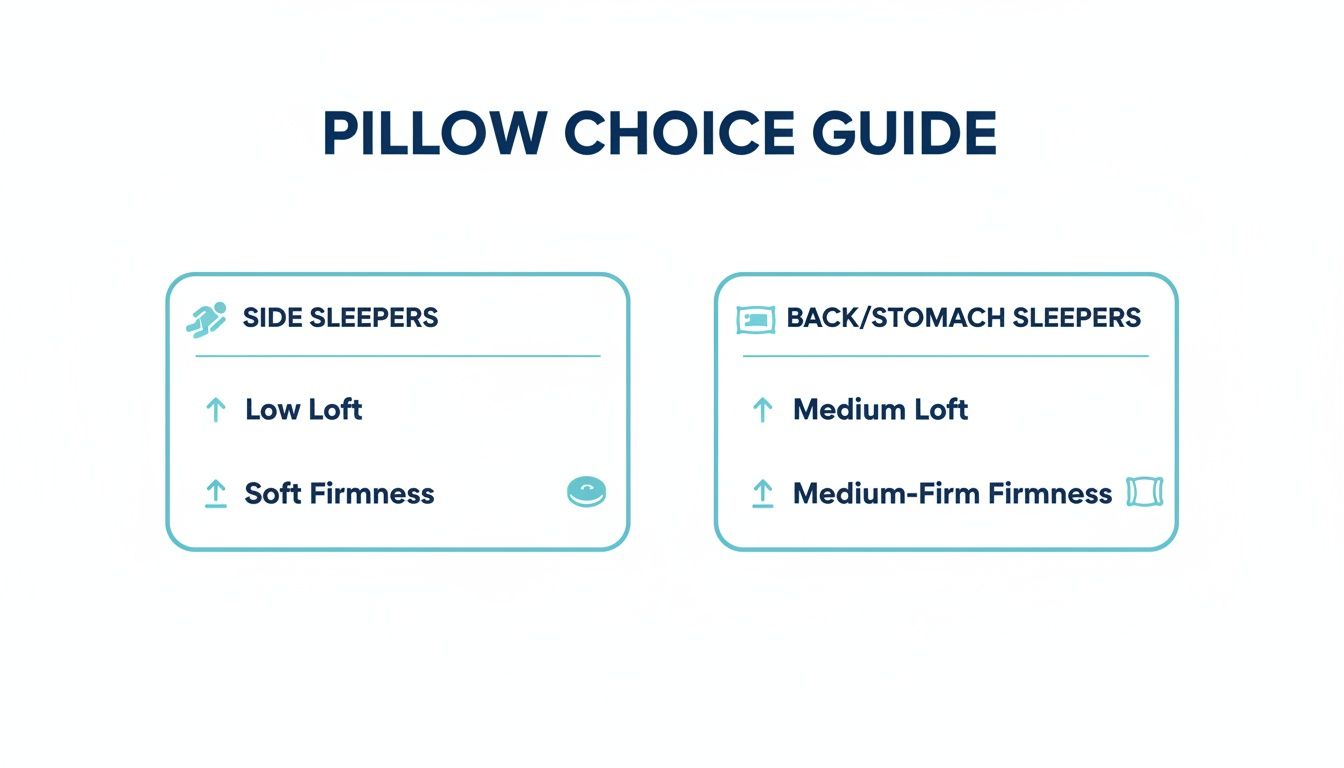
The big takeaway? Your pillow should keep your head as close to the mattress as possible, preventing that awful upward crank on your neck.
Pillow Material Comparison For Stomach Sleepers
Let's dig into the details. Each pillow fill has its own unique personality, and finding the right match can make all the difference. This table breaks down the pros and cons of the most common materials to help you narrow down your search.
| Material Type | Best For... | Pros | Cons |
|---|---|---|---|
| Shredded Memory Foam | Customizable support and pressure relief | Adjustable loft, conforms to your shape, great airflow, hypoallergenic | Can be heavy, may have a slight off-gassing smell initially |
| Latex | Breathable, responsive cushioning | Very durable, sleeps cool, naturally hypoallergenic, resists dust mites | Can be bouncy, less "moldable" than foam, can be expensive |
| Down | Luxurious, cloud-like softness | Extremely soft and compressible, lightweight, molds easily | Requires frequent fluffing, can trigger allergies, loses support over time |
| Down Alternative | A hypoallergenic, affordable soft option | Inexpensive, hypoallergenic, mimics the feel of down | Lacks durability, can clump over time, not as breathable as natural fills |
Ultimately, the "best" material comes down to your personal preferences for feel, temperature, and maintenance. But for stomach sleepers, adjustability is often the winning feature.
Shredded Memory Foam: The Adjustable Champion
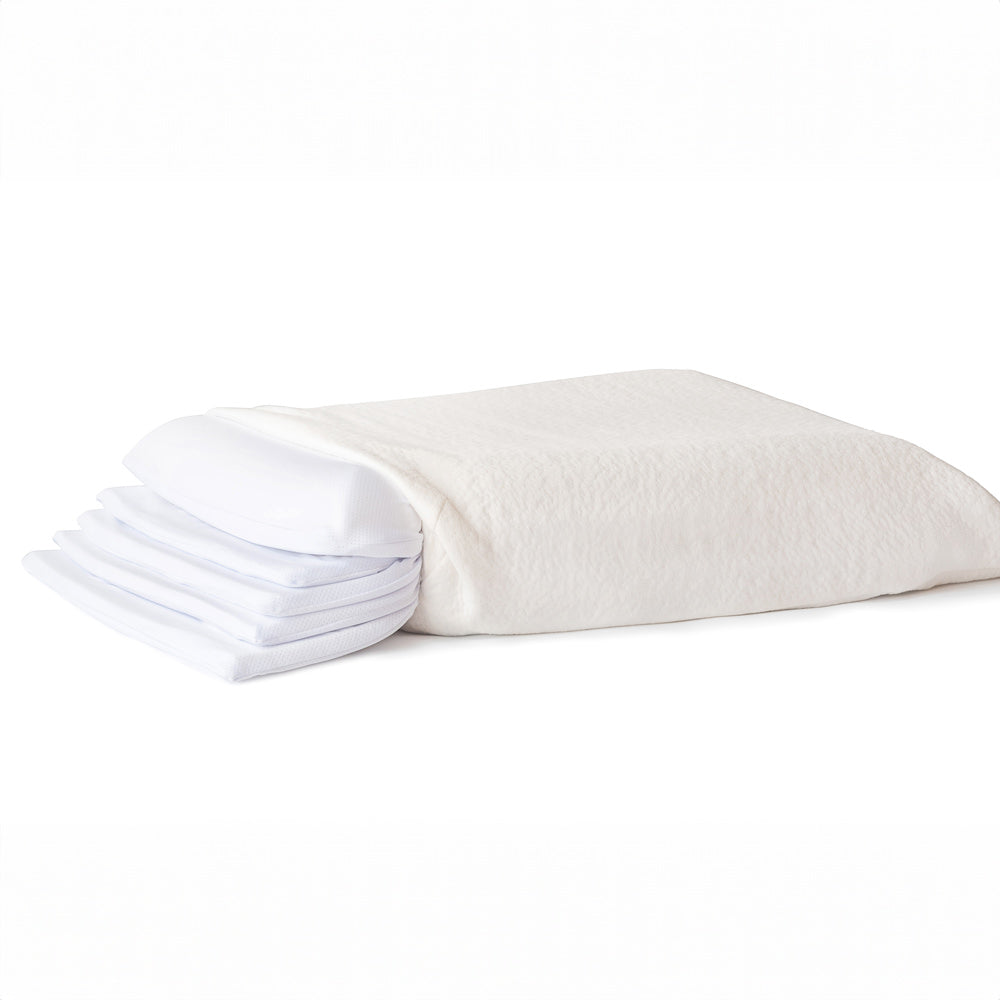
Shredded memory foam is a top contender for stomach sleepers, and for one huge reason: adjustability. These pillows are filled with thousands of tiny memory foam pieces, which means you can add or remove the filling to get that perfect, ultra-low loft you need.
This is a game-changer. Instead of hunting for a pre-made pillow that just happens to be thin enough, you can literally create your own. By taking out most of the fill, you get a nearly flat surface that still provides the fantastic pressure-relieving benefits of memory foam, contouring gently to your head.
Plus, the shredded design allows for much better airflow than a solid block of foam, helping to pull heat away and keep you cool. That ability to fine-tune your support is priceless. You can learn more about its unique advantages in our guide on memory foam pillow benefits.
Latex: A Springy and Breathable Option
Latex pillows, especially those made from natural Talalay latex, bring a totally different feel to the table. They offer a unique blend of softness and responsive support. Unlike memory foam, which slowly cradles your head, latex has a bouncier, more buoyant feel. It compresses easily but springs right back into shape when you move.
For stomach sleepers, a very thin, soft latex pillow can be a fantastic choice. Its biggest strengths are:
- Exceptional Breathability: Latex has a natural open-cell structure that promotes constant airflow, making it one of the coolest materials you can sleep on.
- Durability: High-quality latex is incredibly resilient and will hold its shape for years without developing dreaded flat spots.
- Hypoallergenic: Natural latex is inherently resistant to mold and dust mites, which is a huge plus for anyone with allergies.
The trick is finding one specifically designed with a low loft. A thick latex pillow would be way too high and firm, completely defeating the purpose for a stomach sleeper.
Down and Down Alternatives: The Classic Softness
Nothing quite says "luxurious" like a down pillow. Filled with the fluffy under-feathers of ducks or geese, they are incredibly lightweight and easy to squish into shape. Stomach sleepers can usually flatten a down pillow to a very low height, which is great for keeping the spine aligned.
The real magic of down is its ability to compress almost completely flat under the weight of your head. It offers minimal resistance while still feeling like a soft cushion.
But down isn't perfect. It needs to be fluffed constantly to maintain its loft and can be a nightmare for allergy sufferers. Over time, it can also lose its supportive qualities and trap a surprising amount of heat.
Down alternatives, usually made from synthetic polyester fibers, do a good job of mimicking that soft feel at a lower price point and are hypoallergenic. While they are also very soft and compressible, they tend to be less durable and breathable than real down. For a stomach sleeper, either one can work as long as it isn't overstuffed. The goal is always the same: a pillow you can squash nearly flat with ease.
A Practical Checklist for Finding Your Perfect Pillow
Alright, now that we've covered the basics of loft, firmness, and materials, it’s time to get practical. Picking the right pillow involves more than just grabbing one that feels soft in the store. Personal details, like your body weight and even the type of mattress you sleep on, can make a huge difference in what works for you.
Think about your mattress and pillow as a team. They have to work together. If you have a super-soft mattress that you sink into, you’ll probably need an even thinner pillow to keep your spine straight. On the flip side, a firm mattress holds you more on the surface, so a slightly thicker—but still low-loft—pillow might be needed to gently fill that small gap between your head and the bed.
Key Factors to Consider Before Buying
Your body weight matters, too. Someone heavier will compress a pillow more than a lighter person, which could make a thin pillow feel like it’s not even there. It's all about finding that sweet spot where your head is cushioned just enough without being propped up at an angle.
And let’s not forget about breathability. As a stomach sleeper, your face is right there on the pillow. A material that lets air flow freely is a must to avoid waking up in a sweat.
Your goal is a near-flat surface that offers just enough cushioning for comfort. The pillow shouldn't actively lift your head but should instead feel like a soft, supportive layer between you and the mattress.
This need for precision is why you’ll see more companies getting specific with their product details. Many now list exact loft measurements in inches and provide firmness ratings to help you make a smarter choice. The industry is definitely catching on to how much these details matter for getting good sleep.
Your Stomach Sleeper Shopping Checklist
Whether you're clicking through options online or testing pillows out in person, keep this quick checklist in mind. It will help you ignore the marketing fluff and zero in on what truly counts for a stomach sleeper.
-
Loft (Height): Is It Under 3 Inches? This is the big one. Your starting point should always be a pillow labeled "thin," "low-profile," or "slim." For an adjustable option like the DubsLabs Adjustable Memory Pillow, make sure you can take out enough fill to get it almost completely flat.
-
Firmness: Does It Feel Soft to Medium-Soft? Your pillow should give way easily when you lay your head on it. If you press down and it feels dense or pushes back with a lot of force, it's too firm and will likely cause neck strain.
-
Material: Is It Breathable and Supportive? Look for materials known for great airflow and pressure relief, like shredded memory foam or latex. If you're leaning toward down or a down alternative, just make sure it’s not overstuffed and can be easily squashed down.
-
Shape and Size: Does It Fit Your Needs? A standard pillow shape works for most, but some stomach sleepers like a bigger pillow to hug or a smaller one that just cradles their head. One pillow is almost always enough; stacking them is a surefire way to create too much height. For more on this, check out our guide on how many pillows you should sleep with.
-
Trial Period: Does It Offer a Return Policy? Let's be real—the only way to know if a pillow is the one is to actually sleep on it. A company that offers a risk-free trial period is a huge plus, giving you time to see how your body feels after a few nights.
Walking through these points one by one takes the guesswork out of the process. It's a simple, methodical way to filter your options and get you that much closer to waking up pain-free.
Common Mistakes Stomach Sleepers Make and How to Fix Them
Even when you think you’ve got it all figured out, it’s frustratingly easy to fall into a few common traps. You might buy a pillow specifically labeled for stomach sleepers, only to wake up with that same old crick in your neck. Nailing down these small but critical errors is the last piece of the puzzle for a perfect sleep setup.
Think of this section as your personal troubleshooting guide. We’ll walk through the most frequent missteps stomach sleepers make, explain exactly why they’re causing problems, and give you simple, direct fixes to get you back on track to a pain-free morning.
Mistake 1: Choosing a Pillow That's Still Too High
The number one pitfall is underestimating just how incredibly thin your pillow needs to be. Many so-called "slim" or "low-profile" pillows you'll find online or in stores are still 3 to 4 inches high. For a stomach sleeper, that’s a mountain.
This seemingly tiny height difference is more than enough to force your neck into a slight upward angle, creating strain that builds up all night long. It's an easy mistake to make; a pillow can look perfectly flat in a product photo but feel much loftier once your head is on it.
The Fix: You're aiming for a pillow that is under 3 inches tall when it's compressed by the weight of your head. The most reliable way to hit this target is with an adjustable pillow, like the DubsLabs Adjustable Memory Pillow. You can simply remove the fill until you get that barely-there surface—just enough cushion for comfort without any upward lift. It completely eliminates the guesswork.
Mistake 2: Forgetting Your Hips
It’s common to focus all your attention on your head and neck, but that’s only half the battle. When you lie on your stomach, gravity pulls your midsection down into the mattress, forcing your lower back into an unnatural arch. This misalignment is a huge contributor to morning back pain, no matter how perfect your head pillow is.
Your spine is one connected system. If one part is out of whack, it sends a ripple effect of strain down the line.
Proper spinal alignment for a stomach sleeper isn't just about your head; it’s about maintaining a straight line from your head all the way down to your pelvis. Neglecting your hips is like fixing only half the problem.
The Fix: Slip a second, very thin pillow under your hips and pelvis. This little bit of lift is just enough to prevent your lower back from sagging, encouraging a much straighter, more neutral spine. The pillow should be firm enough to offer support without feeling like you're sleeping on a noticeable bump.
Mistake 3: Using a Pillow That Is Too Firm
While you need a thin pillow, some stomach sleepers lean towards medium-firm options, thinking it equals better support. But for this specific position, too much firmness is a recipe for disaster. A firm pillow actively resists the weight of your head, propping it up instead of allowing it to sink down to a neutral level.
It’s like resting your head on a book versus a soft cushion. The book forces your neck upward, while the cushion gives way and cradles you.
The Fix: Always go for a pillow that’s on the soft-to-medium-soft side. It should feel plush and be easy to compress. Materials like shredded memory foam, down, or quality down alternatives are fantastic choices because they squash down easily. This ensures the pillow cradles your head without pushing back, which is essential for finding the best pillow for stomach sleepers and kicking that morning stiffness to the curb.
By sidestepping these common errors, you can fine-tune your sleep setup and finally get the deep, restorative rest you've been missing.
A Few Lingering Questions About Stomach Sleeping
Even after you've landed on the perfect pillow, a few questions might still be bouncing around in your head. That's completely normal. Getting your sleep setup just right is a process, and having straightforward answers can help you dial everything in for the best possible rest.
Let's tackle some of the most common questions we hear from stomach sleepers. Think of these as the final pieces of the puzzle, giving you the confidence to sleep comfortably and wake up feeling great.
Is It Bad to Sleep on Your Stomach?
While it’s often flagged as the trickiest sleep position due to potential neck and back strain, it’s not inherently "bad"—if you have the right support. The whole game is about minimizing stress on your body. With the correct pillow and mattress combo, stomach sleeping can be perfectly fine.
The key is to create an environment that promotes a neutral spine. That just means your head isn't cranked up at a weird angle and your lower back isn't sagging into the bed.
To pull this off, you generally need two things:
- An ultra-thin pillow (or sometimes none at all) under your head to keep your neck straight.
- A second, very flat pillow placed under your hips and pelvis. This little bit of lift prevents your lower back from arching, which is a classic cause of morning aches.
With the best pillow for stomach sleepers, you can seriously reduce the risks and keep enjoying the position you find most comfortable.
Should Stomach Sleepers Use a Pillow at All?
This is a great question, and the honest answer is: it depends. For some people, especially if their mattress is soft enough that their head and chest sink in evenly, going pillow-free is the best path to a straight spine. In that case, any pillow—no matter how thin—could create an unwanted upward tilt.
However, most of us just like the simple comfort and cushion of having something soft under our heads. An ultra-thin pillow, usually topping out at 2-3 inches high, offers the perfect middle ground. It gives your face a soft surface to rest on without propping your head up at a risky angle.
The ultimate goal is to keep your spine as straight as possible from your head to your hips. Whether you get there with a very flat pillow or no pillow is all about your mattress, your body, and what feels right to you.
At the end of the day, if you use a pillow, it should feel almost like it isn't there—just a soft little buffer between you and the bed.
Can an Adjustable Pillow Work for Stomach Sleepers?
Yes, and honestly, they're often the best choice for stomach sleepers. Adjustable pillows, which are typically filled with shredded memory foam or another removable material, put you in complete control of the height and feel.
This is a massive advantage. Instead of hunting for a pre-made pillow that just so happens to be thin enough, you get to customize one to your exact preference. As a stomach sleeper, you can simply remove most of the fill until the pillow is nearly flat.
This approach gives you a personalized level of soft, cradling support while ensuring the loft is low enough to prevent any neck strain. It completely takes the guesswork out of finding that perfect, barely-there height.
How Do I Know if My Pillow Is Causing Neck Pain?
Your body is pretty good at telling you when something’s off. If your pillow is the problem, you’ll likely notice a few classic signs:
- Morning Stiffness: Waking up with a stiff, sore neck that feels like it needs a good stretch just to get moving.
- Persistent Aches: A dull, nagging ache at the base of your skull or across your upper shoulders that wasn't there when you went to bed.
- Tension Headaches: Headaches that seem to start in your neck and radiate upward toward your forehead.
- Restless Nights: You find yourself constantly fidgeting, turning over, or bunching and punching your pillow to get it right.
For stomach sleepers, a pillow that's too high is the number one offender. It forces your neck into a sustained, awkward upward angle all night long. A good pillow should feel so natural you barely notice it, allowing your head and neck to rest in a neutral position. If you're waking up in pain, your pillow is the very first thing you should investigate.
Finding the perfect sleep setup can transform your mornings from painful to peaceful. The DubsLabs Adjustable Memory Pillow gives you the power to create your ideal loft, ensuring you get the ultra-thin, supportive surface you need for perfect alignment. Explore our collection of sleep solutions at DubsLabs and start your journey to better rest.